Old Bromyard – Journal 2012 no 35
Judith has been busy looking through old copies of the Bromyard News and Record for 1959.
She found a series of ‘Recollections of Old Bromyard’ , contributed by a reader who found them, written by W. Madders, describing aspects of Bromyard ‘about seventy years ago’. That would have been in the late 1800s. Some of them are reproduced in this Journal, on pages 7, 11, 26 and 38.
More recollections of Bromyard—Spital Trees
Taken from articles written by the late W.Madders.
When I was a boy there used to be at Flaggoners Green a spital tree works. I have looked in Chambers dictionary for a definition of what a spital tree is but have failed to find it. It is a local word for a spade or fork handle. Because they used to be made there.
A Mr. Evans was the proprietor, and after his death his nephew, Mr.T.Hinksman, carried it on for a good many years. He was my Sunday School teacher when I attended Wesleyans (the school was then held in a large room belonging to Mr.Jenks, Tanner, in Pump Street).
Several men were employed at Flaggoners Green, sawyers, turners and others, the trunks (ash I believe) were brought by teams of horses from the neighbourhood, and were cut up by manual labour. A pit was made, and one sawyer stood upon the trunk and one below on the pit, one pulled the saw down and the other pushed it up. The top sawyer was the better man and undoubtedly gave rise to the sporting term “He be a top sawyer”. I used to watch the men at work and noticed that the rough handles were placed in very hot water, and then bent to the proper shape, sometimes they broke or split, when they were thrown out to augment the slabs which were sold for firewood, and were eagerly sought for that purpose. It was a great pity that both this factory as well as the Tannery should have to be closed, as they furnished work for about thirty men between them.
Rouse Bros. (George and Edward “Ted”) with their father also used to employ a good many men.
There used to be a Brickyard in the New Road (where the School Cookery Canteen now is) and I well remember seeing the children running with the wet clay in wooden moulds from the brickmakers and placing them in long rows to dry in the sun, preparatory to their being burnt in the kilns.
The late Mr. D. McIntosh, the draper and outfitter, also started a clothing factory in the New Road and employed about twenty hands (this factory has just been taken down and is now the petrol pumps at the bottom of the road).
Passing now to another subject, that brought to remembrance Stage and Mail Coach days. Not that I remember these. But there used to live in the High Street, next door but two to the N. P. Bank, an old gentleman, Mr. T. Godwin, “Tammy” Godwin for short.
I understood that he had been a stage coach driver between Bromyard, Worcester and Hereford. He was a big old gentleman, and used to wear a long gold chain round his neck, which descended across his portly body. He used to come and talk with the late
Mr. T. W.Williams when I was apprenticed there.
I once rode to Worcester in an old coach (a two horse) from the Hop Pole. I wonder what became of it. It would be most interesting to see.
(re-typed by Judith Evans from the Bromyard News & Record, 24th September 1959.)
Old Bromyard- Mop Fairs
Some recollections of Bromyard
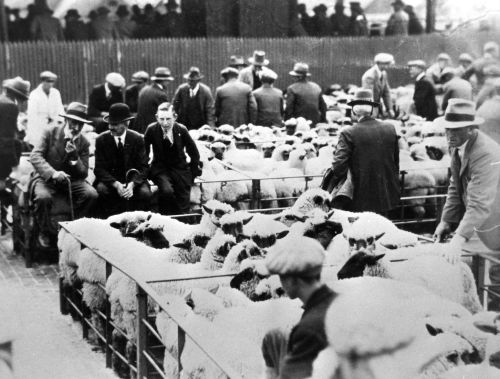
There was no Bromyard Smithfield in my schooldays, but a public market the sheep and pigs being penned in Sheep Street, and I have seen the pens filled from Milvern Lane corner up to Billy Mitchell’s house, which was just past Taylor’s orchard. The cattle stood right from Milvern Lane and down High Street as far as the New Road corner and then up the hill as far as the house just below Hillcrest.
It was said that a farmer named Philpott of the Brook House, Avenbury, had as many as a thousand sheep at Bromyard fair at one time. The pens, as they were called, were kept at Sally Green’s, the name by which she was known, and were erected in the early morning. They were supported by posts driven into the ground and the pens were tied by string to these and to other pens. I know the boys used to plague the sheep, and try to make them jump over the hurdles,
which when they did, there were shouts of delight, and chasing, to bring them back.
These fairs were held about three or four times a year, there being no fortnightly sales.
Hiring fairs or “Mops” as they were called, were held two or three times a year, when farm hands would come to meet would-be employers to whom they offered their services. (You will please remember I was only a boy of between six and twelve years but I used to ask questions of my father and mother and having a fairly retentive memory I almost imperceptibly observed and retained the information
which is now to me so interesting).
I remember seeing one man with a whip in hand which showed he offered himself as a waggoner. At these Mops there used to assemble men with punching machines, and the way in which these amateur “Tom Springs” went for the image was almost alarming to me. Men singing songs and selling the sheets containing the words of the songs, such as “They are going to tax the fleas?” and other sentiments of a rather doubtful character.
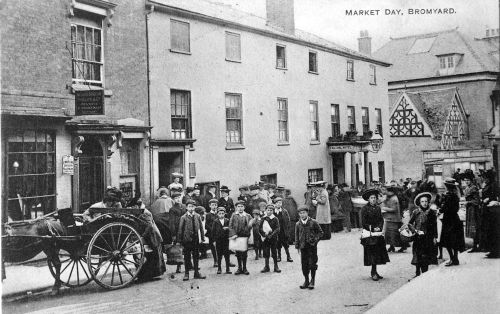
The Mops were held in the Market Square and Broad Street, not in High Street, and any further than Mr.Grubb’s ironmongers shop (which was then opposite Ross’s Boot shop). There were stalls for the sale of nuts, oranges and gingerbreads; also shooting galleries in the Square, where you shot through a long tube at a bell at the further end, if you made a bull’s eye it rang a bell. There were also stalls where you had a gun, one shot a penny at a revolving wheel whereupon was printed on the rim figures one to twelve; whatever number you hit you had the number of nuts; I had twelve once.
A constant attendant at these Mops was an old besom seller named Both who lived on the Downs. He wore a smock frock and used to bring a sort of gaming table on which was a blank and on three other places home made Banbury cakes. I believe one, two and three. You put your money and spun a pointer on a swivel, and on whatever pile it stopped you had that prize. Sometimes you had a blank.
Just when the bicycle was placed on the market there came into the Square a fresh attraction to the ordinary roundabout. This was a collection of machines with pedals attached to each other, and when mounted and the riders pedalled they all went round together on a metal track. I remember seeing a lot of young men going round once and the attendants had to expend considerable time and trouble in acting as brakes to overcome the young men’s energy, to bring
the machines to a standstill. The sympathy of the spectators was, of course, with the ardent racers.
Writing of bicycles reminds me that I saw at Broadwas, when I was very young, a two wooden wheels bicycle which my Uncle George had made. It was about the height of the ordinary safety one now in use. But it had no pedals. It was propelled by the rider sitting astride and
using his legs alternately along the ground. Of course, it was of no use whatever up hill, but he could get along by this method at the rate of eight miles an hour – so he said. I know I was very interested in it. How I practised on an old boneshaker weighing ninety pounds I will tell another time.
(re-typed by Judith Evans from the Bromyard News & Record of 3rd September Record of 3rd September 1959.)
NB: Images from our archive were added for this post for interest.