Articles

24 November 2025ArticlesBDLHS talk by David Parsons, 8th October 2025
The Survey of English Place Names by the English Place Name Society started in 1922. The Herefordshire volume is due for publication next year – based on studies of documents from medieval period onwards.
Languages are organised into:
Modern English French Welsh
Middle English Norse British
Old English Latin
British equates to post Roman Welsh ( also known as Brythonic DH note)
Languages used before British i.e. pre-Celtic are not known.
Romans adopted some existing British names e.g.. Branogenium (Leintwardine) comes from British Branogenos.
Lene – damp as in Leominster.
Maund comes from Magonsaete
Archenfield from Ergyng
Parts of Herefordshire between the Wye and the Monnow were Welsh speaking until the C11 and some until the C18.
Middleton is Miceltune in 1086 (Domesday).
Rivers have always been significant so their names tend to be old and a source of lost languages which have passed between cultures. Welsh (British)names for rivers were adopted by the Anglo-Saxons .
Teme, Tamar, Thames, Tame etc all have related etymology – unceryain but very old.
Humber – lost
Arrow – Alio??
Wye – unknown origin
Frome- from Welsh ffraw meaning lively/brisk
Lugg – from llug meaning bright
Leadon – from llydan meaning broad
Hope and Hop = secluded valley
Nash = at the ash
Noakes = at the oak
Both Nash and Noakes use a fossilised dative/prepositional case ending.
Venn = fen
Vern = fern
Queest , as in Queest Moor is a dialect word for pigeon.
Bylett = island in flood.
French
French has not had much direct influence on English place names .
Belmont has no French origin – name given to hotel and Abbey in 18th and 19th centuries.
Belgate Farm near Byton was connected to Wigmore Abbey which had a French mother house so this probably is French in origin.
Lots of instances of Waterloo used from 1830s .
Acton Beauchamp has a Norman surname added to an English place name.
Use of ‘Court’ is French in origin.
Thruxton is from Norse Thorkell – Norse was fashionable in 8th-9th centuries – unlikely to have been a Viking in Herefordshire.
Golden Valley / Vallée d’Or is from dor, the Welsh for water, not French. In 1128 it was known as Istratour.
Dinmore ( which has a Time Team episode devoted to it) probably means big fort – compared with Denbigh which means small fort.
Use of ‘Street’ is a borrowing from Latin into Early English.
Bury , as in Oldbury, Risbury, Thornbury is from burg meaning fortifications and meant a stronghold before it came to mean a borough.
Anglo-Saxon
Marcle combines 2 words for boundary and wood in the area between the Hwicce and the Magonsaete.
Comberton is a settlement of the Welsh (Cymru).
Aylestone Hill = Aegelmetes Stane (stone) which would have been the moot place for the county.
‘Thing’ is a meeting place.
Wormelow Tump = river worm, a Welsh river name – low and Tump both mean a mound so is an example of the same word in different languages put together.
Worm is Anglo-Saxon for dragon but comes from pre Anglo-Saxon Welsh.
Corn = heron or crane
Ham = bend in the river
Cloud = mass /cloud shaped rock
Staple = bar or post in Early English
Hand = a finger post sign
Wall = well or spring
Burgh = fortifiable place with a wall around it
Keep = cooper /barrels/ baskets
Flaggoner is from Plegel, a person’s name
Landynod = the biblical Land of Nod where Cain was sent after murdering his brother
Wick = specialised farm from vicus
Field names are another topic and a separate talk.
Sapey = the name of a stream
Ocle Pichard = oak wood plus a surname
Plaistow = playing place or arena
Stow = meeting place
Cowarne = cowshed
Day House = dairy house
Arthur’s Stone is C13 usage
Lyonshall – Lenehalle in1086 from lene meaning wet
Harewood = grey or damp wood, nothing to do with hares
From notes taken (in the dark) by Debbie Hughes
About The English Place Name Society
The English Place-Name Society (EPNS) was established in 1923 to conduct a county-by-county survey of the place-names of England. The Survey is used by researchers, academics, and those interested in the origins, meaning, and significance of English place-names.
The Survey is arranged by historic counties: the first volume, covering Buckinghamshire, appeared in 1925; the most recent, volume 96 dealing with part of Shropshire, appeared in 2020. Almost all English counties have been surveyed at least in part and work to complete the Survey is ongoing. This work has been supported by the British Academy since its inception, and by membership subscriptions to the Society, as well as one-off contributions from generous individuals or charitable organisations.
The main resource needed for research and writing of the Survey volumes is time, and time costs money. While substantial research projects for less complete counties will, we hope, be supported by larger funding bodies, we are also in a position to make significant progress on various other counties for which research or draft material exists but needs dedicated time and attention to bring to completion. Our current focus is on The Place-Names of Herefordshire, for which the late John Freeman, the county editor, had produced a draft of the first volume, which will deal with major names (i.e. the names of settlements). A researcher started work on this volume in June 2025, and although the EPNS is in a position to part-fund completion of the volume, we aim to raise additional funds from interested individuals and groups in order to bring it to publication.
The English Place Name Society has a just giving page if anyone would like to make a donation. […]
Read more…
11 November 2025ArticlesBy Louise Manning, originally published in the society journal, 2011The United Brethren were a breakaway sect of the Wesleyan Methodists . After John Wesley’s death the movement broke up into factions. •Religious revival throughout the country with groups looking for a new way of worshipping together.•Social awareness often linked to this religious revival•Individual houses or chapels were licenced for preaching for new churchesBENBOW, John (1800-1874), born at Grendon-Warren, Herefordshire, England –10th of 11 children. His family lived in what is now Winslow, Bromyard. In his early years he worked for Squire Jenks at the Tan Yard in Bromyard and on his farm.John and Jane BenbowJohn married Jane Holmes on the 16thOctober 1826 St Nicholas, Worcester. She was born in January in 1792, Ashperton. They were childless but had adopted John’s niece and nephew Ellen (1825) and Thomas Benbow (1823) on the death of their father.Jane’s family owned The Hill, as well as much property in the local area.
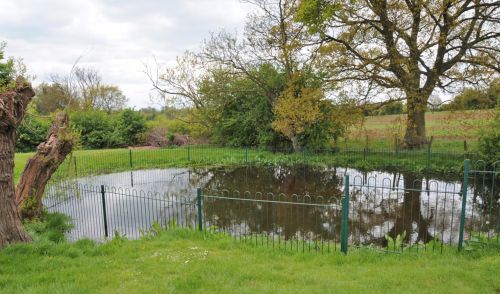
Wilford Woodruff –born March 1807, Farmington, New England –formerly educated until eighteen. In his twenties he searched for the “right” faith in an equivalent religious revival in the US. There were a number of groups being established all looking for whatthey described as the true way. In 1833, Mormon missionaries came to speak in his town and several of his family members converted. He was baptised on December 31, 1833.Between 1831 and 1833 Mormon community in the Independence, Missouri area grew to around 1200 people. They were then forced out of the area. The main body of the Mormon church was in Kirkland, Ohio. Wilford became a Mormon missionary travelling throughout the US from 1834 –1839.The Mormons believed that they would collect to form “Zion”. In 1838, they thought this was “Far West” in Missouri. Persecutions meant that the main body of Mormons then moved to Illinois. They moved to swamp land in Nauvoo and started to try to reclaim the land and form a community. Disease was rife in including malaria.The Journals of Wilford WoodruffWilford was literate and wrote daily in his journals throughout his missions in the US and England. They describe his mission but also a great insight into life at the time.Travelling to HerefordshireWilford Woodruff met William Benbow a grocer in Hanley, Staffordshire who had already converted to the Mormon faith. William suggested that he should travel with him to Herefordshire to meet his brother,John. They took a coach to Worcester and then walked to Castle Frome. United BrethrenMembers of the United Brethren were living in Herefordshire, Worcestershire, and Gloucestershire and had formed into two conferences (preaching circuits), centred at 31 Froome’s Hill and Gadfield Elm. They were influenced by John Bunyon’s Pilgrim’s Progress, early Puritan work•Left the Primitive Methodists in 1832 to form their own group•They had the habit of daily prayer and focused on community and family life.•They would often have agape feasts as a form of worship.Excerpt from Wilford’s journalI found Mr. Benbow to be a wealthy farmer, cultivating three hundred acres of land, occupying a good mansion, and having plenty of means. His wife, Jane, had no children. I presented myself to him as a missionary from America, an elder of the Church of Jesus Christ of Latter-day Saints, who had been sent to him by the commandment of God as a messenger of salvation, to preach the gospel of life to him and his household and the inhabitants of the land. (4th March 1840)He and his wife received me with glad hearts and thanksgiving. After receiving refreshments we sat down together, and conversed until two o’clock in the morning. I also rejoiced greatly at the news Mr. Benbow gave me, that there was a company of men and women—over six hundred in number—who had broken off from the Wesleyan Methodists, and taken the name of United Brethren.They had forty-five preachers among them, and for religious services had chapels and many houses that were licensed according to the law of the land. This body of United Brethren were searching for light and truth, but had gone as far as they could, and were calling upon the Lord continually to open the way before them and send them light and knowledge, that they might know the true way to be saved. Mr Benbow…had in his mansion a large hall which was licensed for preaching, and he sent word through the neighbourhood that an American missionary would preach at his house that evening (5th March).As the time drew nigh, many of the neighbours came in, and I preached my first gospel sermon in the house. I also preached at the same place on the following evening, and baptized six persons, including Mr. John Benbow, his wife, and four preachers of the United Brethren. “I spent most of the following day in cleaning out a pool of water, and preparing it for baptizing in, as I saw many to be baptized there. I afterwards baptized six hundred in that pool of water”. (6th March 1840)
On Sunday, the 8th, I preached at Frome’s Hill in the morning, at Standley Hill in the afternoon, and at John Benbow’s, Hill Farm, in the evening. The parish church that stood in the neighborhood of Brother Benbow’s, presided over by the Rector of the parish, was attended during the day by only fifteen persons, while I had a large congregation, estimated to number a thousand, attend my meetings through the day and evening. A Constable was sent to arrest him for preaching without a license –he listened to themeeting and then put himself forward to be converted.
Benbow’s pond, pictured in 2011
Ministers and Rectors of the south of England called a convention and sent a petition to the Archbishop of Canterbury, to request Parliament to pass a law prohibiting the mormons from preaching in the British dominions.Thomas Kington 1794 -1879He was one of the most important converts among the United Brethren. He was the superintendent of the group from its beginnings in 1832. He was born in Bodenham Herefordshire and by 1828 was a lay preacher for the Primitive Methodists in Alvechurch, Worcestershire. Between 1833 and 1840 he obtained licences for 29 homes and was the most active non-conformist preacher in the Three Counties. He lived at Hill Farm and worked for John Benbow from 1832 until 1839. Hill Farm was the headquarters of the society. In 1839, at the age of 45 he married Hannah Pitt and moved to Dymock. On the 15th March Wilford Woodruff asked to meet Thomas and on the 21st March he and his wife were baptised.
The first forty-one emigrants left Britain on the “Britannia” which sailed from Liverpool in June 1840.On 8th September 1840, John and Jane Benbow emigrated to America with fifty (some sources say 200) others from Liverpool on the ship “North America” The Benbows paid the passage for forty members of the United Brethren. They arrived in New York City, October 11th, 1840.All the emigrants were housed on one desk. Their rations were mainly biscuits and oatmeal.The total journey of over 5000 miles took the Benbow family John, Jane, Thomas and Ellen just over eleven weeks! They initially settled on the prairie in Illinois near Nauvoo where they had a 160 acre farm along with many of the people who had emigrated with them.When they arrived in Nauvoo in the early 1840’s it was an undeveloped settlement with a rural life-style and no industry.The 1841-1842 winter was very cold and the new arrivals had to live with existing families in their houses or else camp outside on plots of land that they had secured. Many of the British who arrived were unable to work because they had come from industrial cities in Britain. It was a distinct advantage at the beginning to come from an agricultural background.Excerpt from Wilford’s JournalThis was the first time I had visited him since my return home…. His farm looked like the Garden of Eden. I have never seen so much work done in one year on a prairie farm… He had surrounded it and crossed it with heavy ditches and planted thorn hedges. His dwelling, barns, sheds, garden, yards and orchards were all beautifully arranged. The farm very must resembled the farms of old England. January 1842In the autumn of 1845, many of the Mormons were driven from their homes in Nauvoo and were forced to move west. They were forced out into the snow and they lived in tents and hastily built wooden “cabins” at temperatures of minus 40°FJane Benbow died on 27 Nov 1846, at Winter Quarters, Douglas, Nebraska
Back […]
Read more…

2 November 2025ArticlesBy Debbie Hughes
On July 8th 2025 we (myself and husband, Peter) set out on our trip to the Norwegian Land Rover Club Rally at Rognan, north of the Arctic Circle in Norway. The distance was too far for one of our historic 1950s Series I Land Rovers so we travelled in a modern Land Rover Discovery. The Land Rover Rally was the main pretext for our trip but Scandinavia, of course, has a wealth of places of historical interest and this is the story of those we visited.
On our way to the ferry port at Harwich we stopped in Colchester – tucked away down side streets we found the C12 remains of St Botolph’s Priory, an imposing Victorian water tower and the remains of a Roman Gateway into the city.
In Oslo the Viking Ship Museum was closed while they construct a new building to house it but we visited the Folk Museum with reconstructed buildings including C17-C18 farm buildings and a wooden stave church dating to 1200s. Not many original stave churches survive due the the fire risk of wooden construction.
The Kon-Tiki Museum in Oslo houses the actual Kon-Tiki balsa wood raft sailed across the Pacific Ocean by Thor Heyerdal and also the Ra II built from papyrus / reeds which Thor Heyerdal sailed from Morocco to Barbados so disproving the long held belief that Columbus was the first to sail across the Atlantic from Europe to the Americas.
Next door to the Kon-Tiki is Fram – the Polar Exploration Museum – the Fram being the ship used by Roald Amundsen on his Antartic Expedition of 1910-1912. The Fram’s hull, modified after earlier expeditions, was massively thick to enable it to withstand the pressure of the polar ice.
Oslo Fortress (Akershus Festning) is also home to the Resistance Museum which tells the story of Norwegian Resistance and the hardship suffered by Norwegians in World War II.
Heading north from Oslo we, of course, stopped at the Arctic Circle Visitor Centre – snowy scenery in an unseasonal temperature of 26°.
On the Lofoten Islands the historical highlight was the Viking Museum on the site of a reconstructed chieftain’s longhouse. The chieftain is thought to be Olav Tvennumbrunni who, rather than submit to unified rule of Norway under Harald Fairhair, went to start a new life in Iceland in the 870s. As well as many artifacts the museum also has a working replica of the Gokstad ship discovered in a Viking grave near Oslo and we were able to have a short trip on her – probably the highlight of the trip for me!
In Stockholm we went to the Vasa Museum where the amazingly intact, preserved 17th century warship, the Vasa, is housed. In 1625 the Swedish King, Gustav II Adolf, commissioned the Vasa which was to be the most powerful warship in the Baltic. Despite earlier concerns about its seaworthiness, the Vasa set off for its maiden voyage on 10th August 1628. Still within sight of the shipyard a gust of wind caused it to heel over, water flooded into the open gun ports and it sank. It sat, preserved in the mud at the bottom of the harbour, until it was finally lifted in 1961and, after years of preservation work, it was finally on display in a purpose built museum in June 1990. 98% of its structure survives so it is an amazingly intact piece of C17 history.
In Gothenburg there was motoring history at the World of Volvo.
We crossed the Oresund from Sweden to Denmark by ferry and arrived in Helsingor where Kronborg Castle is the original Elsinore in Hamlet and provides opportunity to dress up and play at Kings and Queens!
Still in Helsingor the Church of St Mary and Monastery of Our Lady were built in the late C15 – lack of stone and availability of clay meant that brick was used in these parts of northern Europe in these early buildings, making them seem deceptively modern.
Another ferry took us back to Germany and the Hanseatic League town of Lubeck founded in 1143 as the first port on the Baltic Sea and lots more examples of modern looking mediaeval brick.
And so back through Germany, Belgium, Netherlands and France to Calais and home. 4,611 miles in total and we had a fantastic trip, saw lots of fascinating and historic places but there were plenty we couldn’t fit in and scope for another trip, though maybe not quite so far north next time.
Debbie Hughes September 2025 […]
Read more…
19 October 2025ArticlesThis article, by Barry Lawrence, first appeared ine the 2010 society Journal
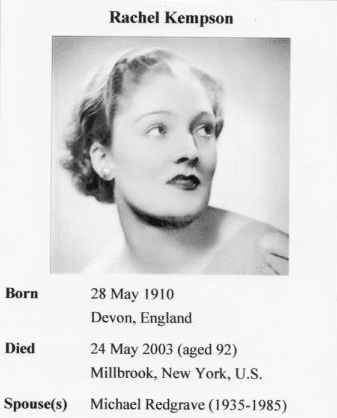
Since coming to live in this area fifteen years ago I have been intrigued by the occasional reference in speech or print to the wartime visits to Bromyard by the children of the MichaelRedgrave/ Rachel Kempson acting family. What were they doing here? Whom were they visiting? What connections did they have with this area? These were questions I hoped I could answer by some diligent searching. Various theories were put to me as to the reason for the visits but nobody seemed to have any positive information.
Over the years I have built up snippets of backgroundmaterial on the Kempson family greatly assistedrecently by the amount of detail available from theinternet. A further impetus was the Centenary of theMorgan Car in 2009 which put the focus on to StokeLacy for it was here in 1836 that the Herefordshirebased Kempson story started.
In that year John Kempson(Senior) who was born in 1751 and was a Druggist from Hornsey in Middlesex purchased Rectory House in Stoke Lacy from Thomas Hill. During his long life (he died in 1851, aged 90) he also purchased the Birchyfields estate. These properties were inherited by his sons John (Junior) –Birchyfields,and William – Rectory House.
William Brooke Kempson, born in 1796 became Rector of Stoke Lacy from 1839 until his death in 1859. It was from him and his wife Elizabeth (nee Robertson) that the Kempson line descended into the 21st century. The couple had seven children – four sons and three daughters. It was two of the sons who particularly interested me but for very different reasons and it was from researching them and their families that the answers to my queries were eventually revealed.
William John Kempson was born in Newcastle upon Tyne in 1835, the first son of his parent’s marriage in 1831. He joined the Army and on his marriage in Pembrokeshire in 1864 he is recorded as a Brevet Major in the 99th Foot Regiment. His bride was LouisaFrances Wedgwood the elder daughter of Henry Allen Wedgwood who was himself the grandson of Josiah Wedgwood of pottery fame. William’s profession meant that the family had no settled home with their first child, Jessie born in Worcester in 1867 and hersiblings, Hester Louisa b.1869, John Wedgwood b.1870 and Lucy Caroline b.1874 all born whilst staying with relatives in Kent. Sadly William died in Folkestone in 1877 of a ruptured aneurism aged only 42 which left his family scattered once again. In the 1881Census Louisa is staying with her sister-in-law Madeleine Kempson at Hampton Park, Hereford whilst her children were with their grandfather Henry Wedgwood now in Cheltenham. In 1887 the family were reunited in the house which was to become their home for the next thirty years. They rented from Mrs.Elizabeth Higgins what was then called “New House” (now Moreton House) at Moreton Jeffries which had been vacated by Rev.Henry George.Morgan who moved to Stoke Lacy Rectory on the death of his father and who was Rector there until 1937. He was the father of the founder of the Morgan Car Company who was born at New House.
New House at Moreton Jefferies
The Kempsons entered into the social life of the district with frequent mentions of their activities in the Diaries of Ruth Bourne of nearby Cowarne Court. In 1903 Louisa Kempson died and both she and her husband are remembered on a window in Stoke Lacy church. Another mystery then presented itself as Louisa’s death is not recorded in any of the U.K. national Death Indexes. It is only recently that due to the previously mentioned internet I found that she died on April 18th in Las Palmas, Grand Canaria with her Death Certificate signed by the British Vice Consul. Passenger Lists record her leaving London for Las Palmas in January of that year accompanied by her daughter. She left a three page Will made in 1899 with her major assets divided between her four children.Regrettably I have been unable to trace where she (or her husband) were buried.The “children”, now all grown up had gone their separate ways and at that time all remained unmarried. Jessie and Hester are recorded as” living on their own means”, whilst John was aLieutenant in the Royal Artillery who then emigrated to America where he ranched for several years only returning to England on the outbreak of the First World War. Lucy Caroline, the youngest daughter is recorded in her obituary as being “among those women who were the first to receive a university education”. She had a distinguished academic career but both she and Hester kept their base at the house in Moreton Jeffries. Hester surprised everyone when in June 1911 at the age of 42 she married Henry Richardson, a retired bank manager from Torquay. The marriage was however a short one as Henry died in 1914 and Hester remained at Moreton Jeffries. After the War John returned to Bromyard as a Captain and built “Whitegate” on the Hereford road – now “Whitegates” and used as a nursing home. He died in London after an operation in 1928 aged 58 and was buried in Stoke Lacy. His three sisters inherited his property but Hester was herself to die in 1930 and is also buried at Stoke Lacy.The house in Moreton Jeffries had to be relinquished in 1918 on the death of John Smith of Thinghill Court who had purchased the Moreton Jeffries Estate in 1898 from the executors of Mrs.Higgins. Jessie who had lived for many years in London also had a cottage in Bosbury and later moved to West Malvern where she died in 1939 leaving her property to her remaining sister Lucy and her jewellery to her great niece Rachel Redgrave. Jessie was buried at Bosbury.By the time of the Redgrave children’s visits to Bromyard in the 1940s and 1950s Lucy Kempson had retired and was living at Whitegate. Ruth Bourne (then Ruth Baily) remarks in her Diary of that time that she was “invited to a sherry party at Lucy Kempson’s charming house in Bromyard”. Miss Kempson had a busy retirement – she was a governor of Queen Elizabeth’s Grammar School, a Cottage Hospital Trustee, a member of the Bromyard Parochial Church Council and had involvement in many other town activities. Unlike the rest of her family she had a long life and died in 1958 aged 83. After cremation her ashes were buried in the grave of her sister Hester at Stoke Lacy.By far the better known of the two brothers, in this locality at least, was Frederick Robertson Kempson who was born in Stoke Lacy in 1838 and who died in Chelsea in 1923. He trained as an architect and in 1866 married Julia Madeleine Jay with whom he had six children amongst whom were Eric William Edward b.1879 and Helena Joan b.1882.Frederick Kempson became a Diocesan Architect in the 1860s and as such was responsible for the restoration or rebuilding of many of Herefordshire’s churches including Stoke Lacy (1863) and St.Paul Tupsley (1864).Frederick’s second son Eric married Beatrice Ashwell in Totnes in 1908 and it was in Dartmouth where he was a master at the Royal Naval College that his daughter Rachel was born in May 1910. Eric Kempson became a Major in the Royal Engineers during the First World War where he saw service in Egypt. He died in London in 1948 aged 69.Eric’s sister Helena had a distinguished nursing career and retired to Dumbleton Cottage in Church Street, Bromyard and like her kinswoman Lucy had a very active retirement involving herself giving lectures and demonstrations for the Britsh Red Cross and becoming the Society’s County Nursing Superintendant. She too was a member of the Bromyard P.C.C. and assisted the town in many other ways. She died in December 1957 aged 75. Amongst the mourners was Lucy Kempson who was herself to die three weeks later and at both funerals “Mrs.Michael Redgrave” who was by then the famous actress Rachel Kempson and themother of Vanessa, Corin and Lynn.It is obvious from my researches that Rachel Kempson, her father Eric, and later her children kept in constant contact with the family in Bromyard and sought there the relative peace and tranquillity during the days of the Second World War. The two Miss Kempsons still living in the town at that time must have had many storiesto tell these young children and it is good to know that the family name is perpetuated today in the playing fields off York Road.
Back […]
Read more…
13 October 2025ArticlesBy Jean Hopkinson. This article was first published in the 2011 society Journal.
A strong wind rolled dark brown ‘golf balls’ down the bank at the end of the Bromyard underpass in August and I remember resolving to find out which conifer had borne the cones. I then forgot about them until reading through a file of Phyllis Williams’sworking papers in the History Centre I came across the following invoice dated Christmas 1890 amongst others relating to Mr James Jenks’s business at the Tan Yard in Pump Street:A.Marshall, High St., Bromyard, Green Grocer, Fruiterer, Florist etc.1 Wellingtonia 10s 0d1 Irish Yew 4 01 Cupresus 5 0Men getting up and planting tree 1 02 men ¾day each, 1¼ days 4 61 laurel tinns 2 61 Cupresus Erecta 4 0Purple beech tree 5 0
From the Ordnance Survey map surveyed in 1884 it appears that there was no garden next to the Tan House, however it does show that the present Nunwell Surgery, on the opposite side of the road, stands on a sizeable plot marked Tannery that may havefilled this role. The area, which by 1845 had already been cleared of the burgage plots developed by the bishop of Hereford in the 12th century, was an orchard and extended from the boundary with Nunwell House to include all the land at present occupied by the surgery, the width of the bypass and the ground up to the row ofcottages that stand on the west of Tower Hill. It fronted onto Pump Street, and on the west was bounded by a footpath which still stretches from Highwell Lane to the top of Little Hereford Street, passing a kissing-gate now beached forlornly at Old DitchCottage. When the surgery was still in Nunwell House this land was a paddock where Dr King-Lewis kept a pony for his trap before he acquired a Daimler.
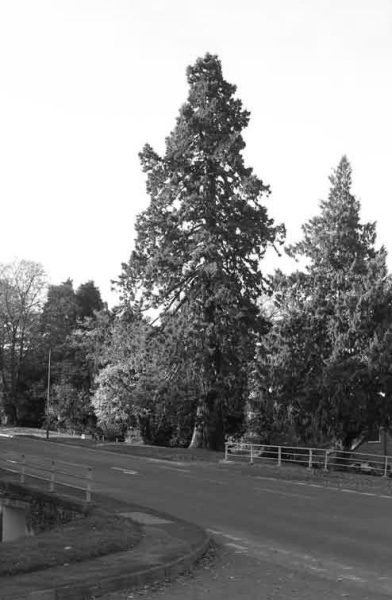
Being in the tanning business Mr Jenks would have been knowledgeable about the properties of various woods, and probably chose his purchases with care. There appear to have been six pits in the middle of the plot and maybe the intention was for the new trees to act as a screen. I determined to see if any had survived.There is no sign of the Irish yew and a Laurelstinus might not be expected to live that long. There is, however, a pallid offspring of the purple beech, and happily spared when the bypass was put through in 1966-7 is a towering Wellingtonia only six yards from the pavement, whose cones are the origin of my ‘golf balls’ and which can remain green and hang on the tree for twenty years. Standing on council land, it is automatically protected and there is no need for one of the tree preservation orders first introduced as part of the Local Government Act of 1947. Wellingtonias were brought to Britain in 1854 and the naming of the tree after the Duke ofWellington who had died two years previously, caused an international row between the British and the Americans who wanted it called the ‘Washington’. After years of dispute it was finally named Sequoiadendron giganteum because of its similarity to the Coast Redwood, Sequoia sempervirens.Among other conifers are several Cupressus Lawsonia with their small spherical cones, augmented by two possible White Cedars, Thuja occidentalis, with cones that turn an attractive yellowish green as they mature; ‘by their fruits ye shall know them!’ I have visited the surgery since 1964 and never noticed the spectacular tulip tree by the entrance. Across the bypass in what remains of Mr Jenks’s garden is Nunwell Park carefully preserved as an open space thanks to the foresight of the then parish council and now home to Time Tower, Philip Bews’s sturdy Millennium wooden sculpture. There are also a couple of London Plane trees, but unfortunately it is impossible to say whether Mr Jenks bought these.I have no doubt, however, that the magnificent Wellingtonia was the one planted by him, a generous benefactor during his lifetime, still ‘benefactoring’ Bromyard over a century later.SourcesB&DLHS/AWa B56/2/8 Bills relating to Mr Jenks’ business at the Tan YardRoger Phillips, Trees in Britain (1983)Ordnance Survey 1887bbc co.uk/gardening/design – Victorianwikipedia.org/wiki/sequioadendronwww.bewsgorvin.co.uk […]
Read more…
10 October 2025ArticlesBy Hugh Langrishe.
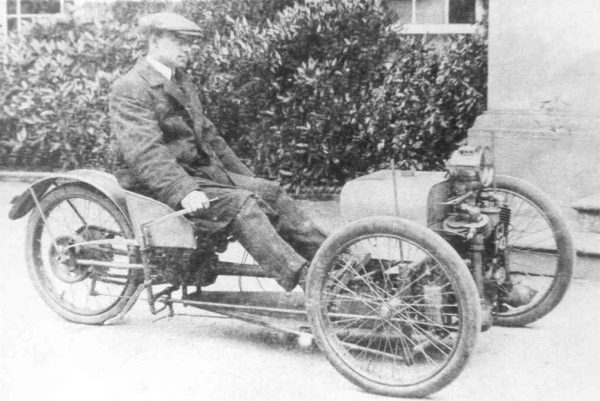
This article first appeared in the 2010 society Journal. The Rev. Prebendary Henry George Morgan was a keen motorist owning several motor cars before 1910. They were serviced and repaired by A&E Pettifer in their Rowberry Street garage, as were the early cars of his son Henry Frederick Stanley Morgan also known as Harry Morgan or HFS. Albert Pettifer was a keen motorist and one of 35 drivers to tackle the first Shelsley Walsh Hill Climb in 1905. HFS also gained a taste of competitive motoring when he entered the Shelsley Walsh Hill Climb on 13 July 1907. He also competed in the 1906 Fromes Hill, hill climb.It was not until 1910, approximately five years after Pettifer’s new garage was built replacing the old one which had burnt down, that Mr. Pettifer was commissioned to build the first body and chassis for HFS’s final prototype single-seater three wheeler “Runabout”. This was the final development of the first car to be fitted with a Peugeot Vee-twin engine.The 1910 car was shown at the 1910 Olympia Motor Show. It attracted much favourable comment but few orders. Those that were built were bodied by Pettifer. For the 1911 Motor Show the car was re-bodied as a two seater, again by Pettifer, and attracted many orders.HFS accepted an offer by Harrods for an exclusive agency which lasted for about a year although there were at least two other agencies. All chassis were delivered to London and Harrods arranged all body building. By August 1912 construction of bodies for the Morgan Runabout ceased in Bromyard as distance from Malvern and increasing demand for the car was beyond the ability of Albert Pettifer to provide successfully. Instead HFS used the resources of William Clare Coach Builders, ½ mile from the Morgan Co. Works.The panels for Pettifer bodies were shaped in his tinsmith’s shop which occupied the upper floor of the small detached building in Tin Pan Alley, between Broad and Rowberry streets. They were assembled on the chassis in the garage. The wooden patterns for the body patterns were cut in the upper floor of the building across the yard. In those early years of the motor car, manufacturers did not build their own bodies and supplied the chassis “bare”. It is possible that Pettifer used his experience from building the Morgan bodies to offer a body-building service to other car owners in the area.Connection between HFS/Malvern College/Pettifers/Stoke Lacy and the Morgan PrototypeHFS was also a keen cyclist and would cycle from Malvern to Stoke Lacy. He tried a motor cycle but after a short while turned his thoughts to a ‘cyclecar’ which would be light and flexible to accommodate hills and poor roads around the area. In Malvern, his friend was William J. Stephenson-Peach, engineering master at Malvern College. HFS was an engineer but his true talent lay in his ability to merge the best features of contemporary design to create the simplest yet most efficient vehicle of its type adding his own additions like independent suspension, better weight distribution and reduced weight in the braised chassis. Items werebought from local suppliers and the body framework was made of wood in the carpenter’s shop. The 3-wheel prototype was tested on his frequent visits to his family in Stoke Lacy during 1909 and the stables would have been used also as temporary workshop as modifications were made en route. Finally the crude model was entrusted to A.E. Pettifer of Bromyard where his workmen’s expert skills could produce high quality brazing to create the supports, chassis and body parts in his tinsmith’s shop and garage on Rowberry Street.
Hugh Langrishe 2010
Back […]
Read more…
11 September 2025ArticlesOne of the most famous polar shipwrecks has been filmed in detail on the sea floor for the first time.
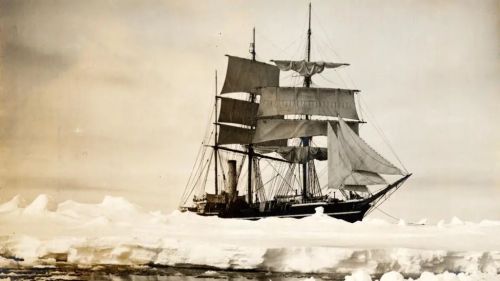
The Terra Nova carried Captain Scott and his men on their doomed expedition to reach the South Pole more than a century ago.
Terra Nova – Getty Images / Royal Geographic
The British party lost the race to the pole, and died on their return journey in 1912.
The footage shows the Terra Nova colonised with sea life, but key features of the wooden ship are still visible including its wheel, winch and mast.
The wreck lies 170m down off the coast of Greenland. After the polar expedition with Scott, the ship continued in service and eventually sank in 1943 while carrying supplies to US bases during World War Two.
The Terra Nova was discovered in 2012 by the Schmidt Ocean Institute, but the new expedition has been the first opportunity to record extensive footage of the wreck.
For the full story visit the BBC website here
Back […]
Read more…